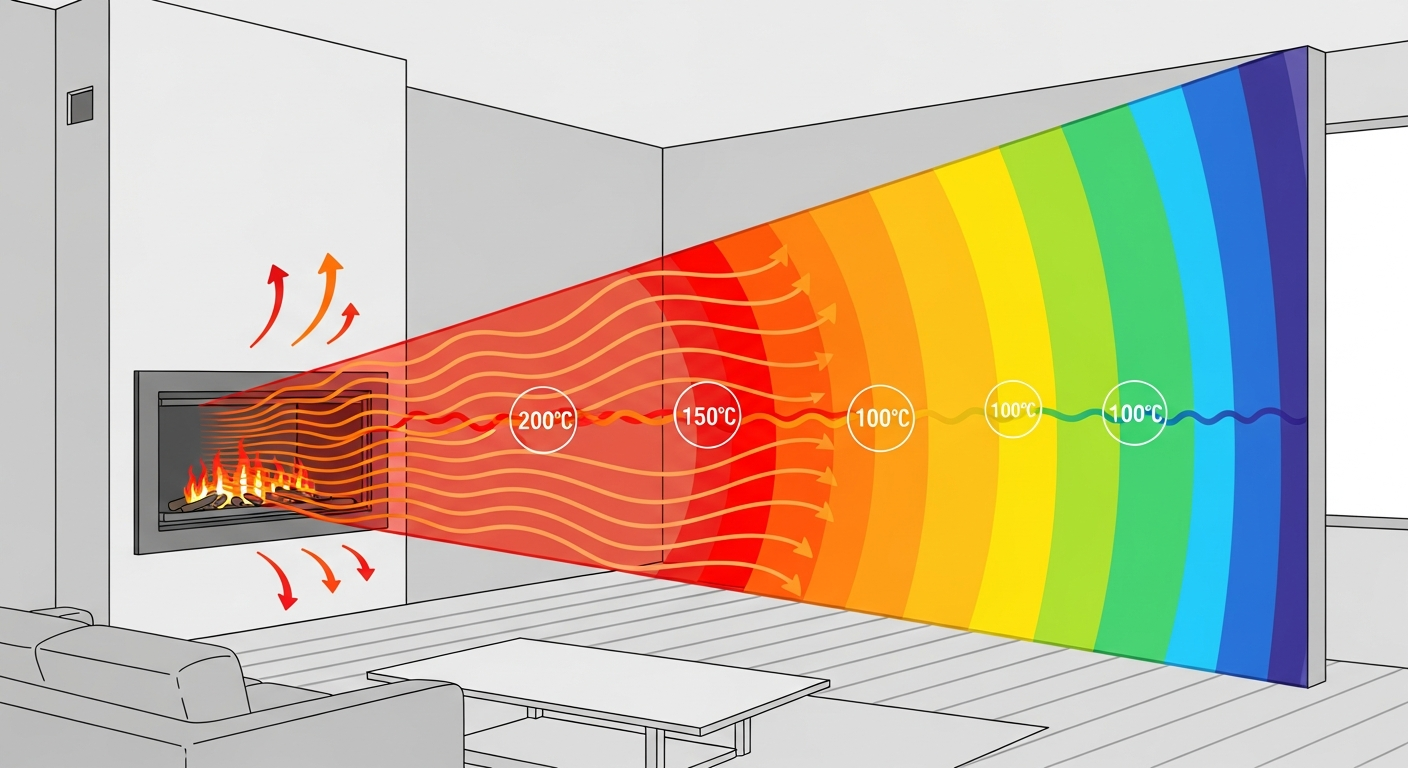
Choosing the right heat output (measured in kilowatts, kW) is crucial for fireplace comfort and efficiency. Too little heat leaves you cold; too much wastes fuel and makes the room uncomfortably hot. This guide will help you calculate the correct heat output for your Romanian home.
Why Heat Output Matters
Oversizing Problems:- Room becomes uncomfortably hot
- Wasted fuel and higher running costs
- Reduced efficiency (fireplace runs at low output)
- Potential damage from excessive heat
- Discomfort and poor experience
- Insufficient heat output
- Fireplace struggles to heat room
- Higher fuel consumption (running constantly)
- Disappointment with performance
- May need supplementary heating
- Comfortable room temperature
- Efficient fuel consumption
- Optimal fireplace performance
- Lower running costs
- Better long-term satisfaction
Basic Heat Output Calculation
Step 1: Calculate Room Volume
Formula:Room Volume (m³) = Length (m) × Width (m) × Height (m)
Example:- Room length: 5 meters
- Room width: 4 meters
- Ceiling height: 2.5 meters
- Volume: 5 × 4 × 2.5 = 50 m³
Step 2: Apply Basic Heat Requirement Formula
Standard Formula:Basic Heat Requirement (kW) = Room Volume (m³) × 0.04 kW/m³
Example:- Room volume: 50 m³
- Basic requirement: 50 × 0.04 = 2 kW
Adjustment Factors
The basic calculation assumes average conditions. You must adjust for your specific situation.
Factor 1: Insulation Quality
Well-Insulated Modern Home:- Multiply by: 0.8-0.9
- Example: 2 kW × 0.85 = 1.7 kW
- Applies to: New builds (2010+), well-insulated renovations, energy-efficient homes
- Multiply by: 1.0 (no change)
- Example: 2 kW × 1.0 = 2 kW
- Applies to: Standard homes, typical Romanian construction
- Multiply by: 1.2-1.5
- Example: 2 kW × 1.3 = 2.6 kW
- Applies to: Older buildings, uninsulated walls, single-glazed windows, drafty homes
- Check when home was built
- Look for insulation in walls/roof
- Check window quality (double/triple glazing)
- Feel for drafts around windows/doors
- Consider energy bills (high bills suggest poor insulation)
Factor 2: Climate and Location
Romanian Climate Zones: Bucharest and Central Regions:- Multiply by: 1.0 (standard)
- Average winter temperatures: -5°C to 5°C
- Standard calculation applies
- Multiply by: 1.3-1.5
- Colder winters: -10°C to -5°C average
- Higher heat loss
- Example: 2 kW × 1.4 = 2.8 kW
- Multiply by: 0.9-1.0
- Milder winters: 0°C to 8°C average
- Less heat loss
- Example: 2 kW × 0.95 = 1.9 kW
- Multiply by: 1.2-1.4
- Colder than central regions
- Example: 2 kW × 1.3 = 2.6 kW
Factor 3: Room Characteristics
Open-Plan Spaces:- Add: 20-30% to calculated requirement
- Heat spreads to adjacent areas
- Higher heat loss to other spaces
- Example: 2 kW + 25% = 2.5 kW
- Add: 10-15% per large window
- Windows lose heat faster than walls
- Single glazing loses more than double
- Example: 2 kW + 12% = 2.24 kW
- Add: 15-20%
- Heat loss through floor
- Basements, garages below
- Example: 2 kW + 17% = 2.34 kW
- Add: 10-15%
- More external surface area
- Higher heat loss
- Example: 2 kW + 12% = 2.24 kW
- Add: 10-15%
- More volume to heat
- Heat rises and stratifies
- Example: 2 kW + 12% = 2.24 kW
- Add: 10-15%
- Heat loss through ceiling
- Poor attic insulation
- Example: 2 kW + 12% = 2.24 kW
Factor 4: Usage Pattern
Primary Heat Source (Daily Use):- Use full calculated requirement
- Fireplace will run regularly
- Needs to handle coldest days
- No adjustment needed
- Can reduce by: 10-20%
- Central heating provides base heat
- Fireplace adds extra warmth
- Example: 2 kW - 15% = 1.7 kW
- Can reduce significantly: 30-50%
- Heat output less important
- Focus on visual appeal
- Example: 2 kW - 40% = 1.2 kW
Complete Calculation Example
Let's work through a real example:
Room Details:- Dimensions: 6m × 5m × 2.5m
- Location: Bucharest (central Romania)
- Insulation: Average (standard home)
- Room type: Living room, open-plan to kitchen
- Windows: Two large windows (double glazed)
- Usage: Primary heat source
- Room above: Bedroom (heated)
- 6 × 5 × 2.5 = 75 m³
- 75 × 0.04 = 3 kW
- Insulation: Average = ×1.0 → 3 kW
- Climate: Bucharest = ×1.0 → 3 kW
- Open-plan: +25% → 3.75 kW
- Large windows: +12% → 4.2 kW
- Usage: Primary = no reduction → 4.2 kW
Quick Reference Table
Use this table for quick estimates (adjust for your specific factors):
| Room Size (m²) | Ceiling 2.5m | Ceiling 3.0m | Notes |
|---|---|---|---|
| 15 m² | 1.5 kW | 1.8 kW | Small room |
| 20 m² | 2.0 kW | 2.4 kW | Medium room |
| 30 m² | 3.0 kW | 3.6 kW | Large room |
| 40 m² | 4.0 kW | 4.8 kW | Very large room |
| 50 m² | 5.0 kW | 6.0 kW | Open-plan space |
Special Considerations
Multiple Rooms Heating
If your fireplace will heat multiple rooms:
Option 1: Calculate Each Room Separately- Calculate requirement for largest room
- Add 30-50% for adjacent rooms
- Total = Largest room + 30-50%
- Measure all connected spaces
- Calculate total volume
- Apply standard formula
- Add 20% for heat distribution
- Living room: 50 m³
- Kitchen (open): 30 m³
- Total: 80 m³
- Requirement: 80 × 0.04 = 3.2 kW
- Add 20% for distribution: 3.8-4 kW
High-Efficiency Systems
If choosing a high-efficiency fireplace (80%+ efficiency):
- Can sometimes choose slightly lower output
- More efficient heat transfer
- Better heat distribution
- Consult manufacturer recommendations
Variable Output Fireplaces
Many modern fireplaces offer variable output:
- Minimum output: For mild days and ambiance
- Maximum output: For coldest days
- Flexibility: Adjust to conditions
Common Mistakes
Mistake 1: Using Room Area Instead of Volume
Wrong: 20 m² room = 2 kW Right: 20 m² × 2.5m height = 50 m³ = 2 kW Why: Volume matters more than floor area for heating.Mistake 2: Ignoring Insulation
Wrong: Using standard calculation for poorly insulated home Right: Adjust for insulation quality Impact: Undersizing leads to insufficient heat.Mistake 3: Not Accounting for Open-Plan
Wrong: Calculating only main room Right: Adding percentage for adjacent spaces Impact: Insufficient heat for entire space.Mistake 4: Oversizing "To Be Safe"
Wrong: Choosing 6 kW for 3 kW requirement Right: Stay within 20% of calculated requirement Impact: Wasted fuel, discomfort, reduced efficiency.Mistake 5: Using Maximum Output for Sizing
Wrong: Choosing based on maximum possible output Right: Choose based on typical operating output Impact: Oversizing if maximum output is much higher than typical.Online Calculator Tools
While manual calculation gives you understanding, online tools can help:
What to Look For:- Room volume input (not just area)
- Insulation factor options
- Climate/location adjustments
- Multiple factor inputs
- Tools provide estimates
- May not account for all factors
- Use as starting point, not final answer
- Professional assessment is best for complex situations
When to Get Professional Help
Consult an expert if:
- Complex room layout - Multiple levels, unusual shapes
- Uncertain about insulation - Hard to assess quality
- Multiple rooms - Complex heat distribution
- Unusual factors - High ceilings, many windows, poor insulation
- Want confirmation - Double-check your calculations
- Planning new build - Early planning prevents mistakes
- Accurate room measurements
- Insulation assessment
- Heat loss calculations
- Product recommendations
- Installation planning
Fireplace Output Ranges
Understanding typical output ranges helps you choose:
Electric Fireplaces:- Range: 1-2 kW typically
- Best for: Small rooms, supplemental heat
- Limitations: Lower maximum output
- Range: 1-3 kW typically
- Best for: Small to medium rooms, decorative
- Limitations: Lower maximum output
- Range: 3-12 kW typically
- Best for: Small to large rooms
- Flexibility: Variable output common
- Range: 4-15 kW typically
- Best for: Medium to large rooms
- Flexibility: Can adjust fuel amount
- Range: 5-12 kW typically
- Best for: Medium to large rooms, whole-house
- Flexibility: Automated variable output
- Range: 4-12 kW typically
- Best for: Medium to large rooms
- Flexibility: Adjustable air control
FAQ
Q: Can I use room area instead of volume?A: No. Volume (length × width × height) is essential because heat fills the entire space, not just the floor area. Ceiling height significantly affects heating requirements.
Q: What if my calculation doesn't match available fireplace outputs?A: Choose the closest match within 20% of your calculated requirement. Slightly higher is better than significantly lower. For example, if you need 3.5 kW, choose 3-4 kW model.
Q: Do I need different calculations for different fuel types?A: No. Heat output (kW) is the same regardless of fuel. However, efficiency affects how much fuel you need to achieve that output. A 5 kW wood fireplace and 5 kW gas fireplace produce the same heat.
Q: What about rooms with vaulted or sloped ceilings?A: Use average ceiling height or calculate volume more precisely. For sloped ceilings, measure at highest and lowest points, use average. Vaulted ceilings may need 10-15% adjustment upward.
Q: How do I account for rooms that are always cold?A: Add 15-20% to your calculation. Cold rooms suggest poor insulation or heat loss issues that need compensating.
Q: Can I use a fireplace with higher output than calculated?A: Yes, if it has variable output control. Choose a model where your calculated requirement falls in its operating range. Avoid models where minimum output exceeds your needs.
Q: What if I'm heating multiple rooms?A: Calculate for the largest room, then add 30-50% for adjacent spaces. Alternatively, calculate total volume of all connected spaces and add 20% for heat distribution.
Q: Do I need to recalculate if I improve insulation later?A: Not necessarily. Better insulation improves efficiency and reduces running costs, but your fireplace will still work. You may find you use lower output settings more often.
Q: How accurate are online calculators?A: They provide reasonable estimates but may not account for all factors. Use them as starting points, but consider professional assessment for important decisions.
Q: What's the margin of error in these calculations?A: With all factors properly considered, calculations are typically within 10-15% of actual needs. This is why choosing within 20% of calculated requirement is recommended.
Next Steps
Now that you can calculate heat output:
- Measure your room - Get accurate dimensions
- Assess your factors - Insulation, climate, room characteristics
- Calculate requirement - Use formulas and adjustments
- Browse fireplaces - Find models matching your kW requirement
- Get confirmation - Book a consultation to verify your calculations
Related Guides
Explore Products by Heat Output
- Wood-burning fireplaces (4-15 kW)
- Gas fireplaces (3-12 kW)
- Pellet stoves (5-12 kW)
- Wood stoves (4-12 kW)
Need help with your calculations? Our expert team can assess your space and recommend the right heat output for your needs. Book a consultation for personalized guidance.