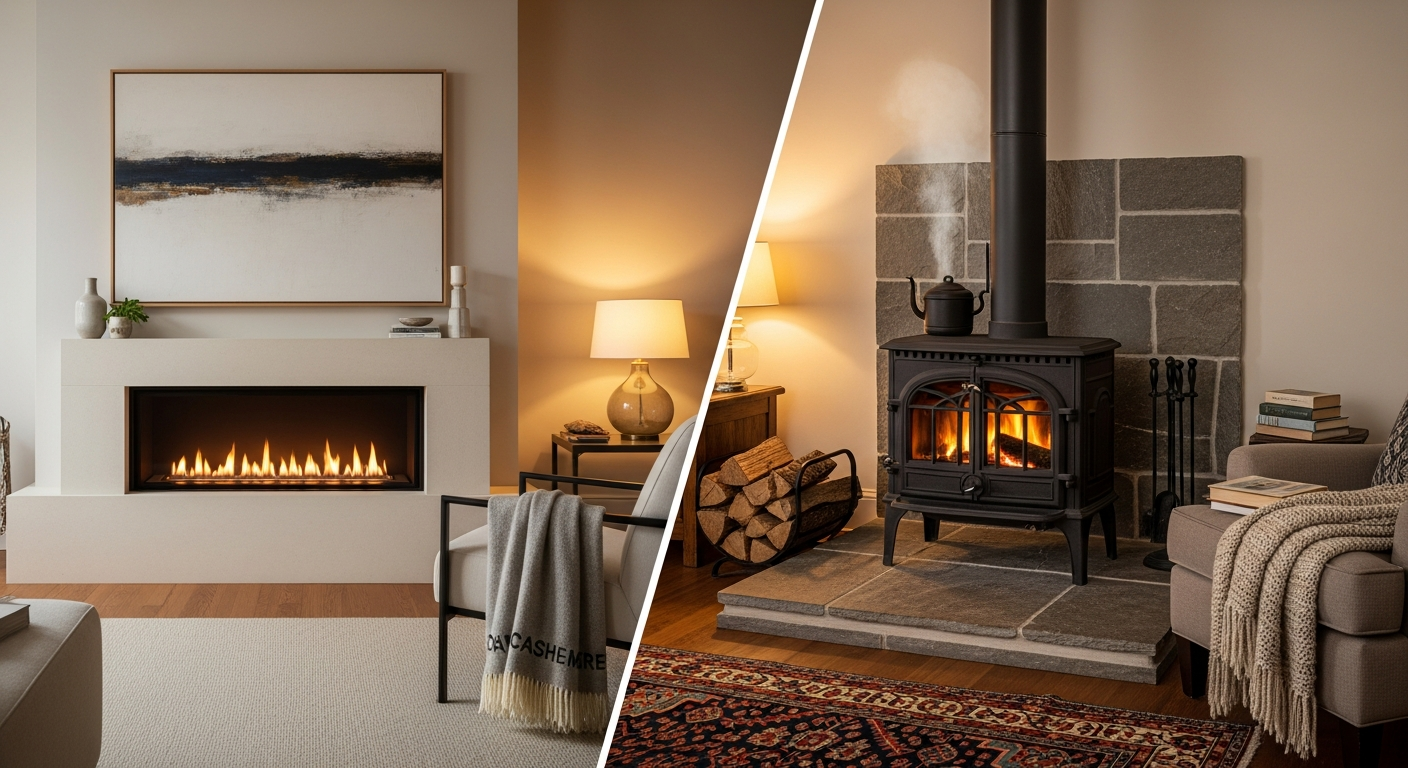
Choosing between a fireplace and a stove is one of the first decisions you'll face when planning your heating solution. While both provide warmth and ambiance, they serve different purposes and suit different spaces. This guide will help you understand the key differences and choose the right option for your Romanian home.
Key Differences at a Glance
Fireplaces are typically built into walls or structures, creating a focal point that's integrated into your home's architecture. They're often chosen for their visual impact and the way they define a space. Stoves are freestanding units that sit in your room, offering more flexibility in placement and often superior heating efficiency. They're typically chosen for practical heating performance.Both can burn wood, pellets, or gas, but their form and function differ significantly.
Aesthetics and Design Impact
Fireplaces: Architectural Integration
Fireplaces are designed to be part of your home's structure. They create a built-in focal point that can:
- Define room layout - Often the centerpiece around which furniture is arranged
- Support architectural style - Can be modern, traditional, or minimalist
- Create visual impact - Large viewing areas, dramatic presentations
- Integrate with design - Can be surrounded by stone, tile, or custom materials
- Built into wall or structure
- Large viewing area
- Can be flush or recessed
- Often part of larger architectural feature
- Creates permanent room feature
Stoves: Freestanding Flexibility
Stoves stand independently in your space, offering:
- Flexible placement - Can be positioned where heat is needed most
- Portable option - Some models can be moved (with flue modifications)
- Focused heat source - Efficient heat distribution from central point
- Design statement - Modern stoves are design objects in their own right
- Freestanding unit
- Takes up floor space
- Can be moved (with limitations)
- Often more compact
- Creates focal point without structural integration
Installation Complexity
Fireplace Installation
Built-in Fireplaces:- Require framing and structural work
- Need wall or structure modification
- Permanent installation
- More complex construction
- Typically higher installation costs
- Structural support
- Framing work
- Flue/chimney integration
- Finishing work (surrounds, materials)
- Professional installation usually required
Stove Installation
Freestanding Stoves:- Simpler installation process
- Less structural work required
- Still need flue connection
- Clearance requirements must be met
- Can be easier to retrofit
- Flue/chimney connection
- Clearance distances
- Floor protection (if required)
- Professional installation recommended
Heat Distribution and Efficiency
How Fireplaces Heat
Heat Distribution:- Radiant heat from large surface area
- Heat rises and circulates naturally
- Can heat larger areas effectively
- Open designs lose significant heat up chimney
- Closed designs much more efficient
- Open fireplaces: 10-30% (much heat lost up chimney)
- Closed fireplaces: 60-85% (modern designs)
- Gas fireplaces: 70-90%
- Electric fireplaces: 100% at point of use
How Stoves Heat
Heat Distribution:- Concentrated radiant heat from unit
- Convection currents circulate heat
- Very efficient heat transfer
- Can heat whole rooms effectively
- Superior efficiency ratings
- Wood stoves: 70-85% (modern EcoDesign models)
- Pellet stoves: 80-90%
- Gas stoves: 75-90%
Space Requirements
Fireplace Space Needs
Floor Space:- Built into wall (no floor space taken)
- May require clearance in front
- Surround area for safety
- Permanent room feature
- Defines room layout
- Furniture arranged around it
- Creates architectural feature
- Less flexible placement
- Medium to large rooms (20m²+)
- Open-plan spaces
- Rooms where fireplace is focal point
- Spaces with wall space for integration
Stove Space Needs
Floor Space:- Takes up floor space (typically 0.5-1.5m²)
- Requires clearances on all sides
- Can be positioned flexibly
- More compact than fireplaces
- Can be placed where heat is needed
- Doesn't require wall integration
- More flexible room layout
- Can be moved (with limitations)
- Small to large rooms (15m²+)
- Any room with adequate clearances
- Spaces where flexibility matters
- Rooms needing focused heat source
Cost Comparison
Initial Purchase Costs
Fireplaces:- Electric: €300-€2,000
- Gas: €1,500-€8,000
- Wood-burning: €2,000-€15,000+
- High-end designer: €10,000-€50,000+
- Wood stoves: €1,500-€8,000
- Pellet stoves: €2,500-€8,000
- Gas stoves: €2,000-€6,000
- High-end models: €5,000-€15,000+
Installation Costs
Fireplaces:- Simple built-in: €1,000-€3,000
- Complex installation: €3,000-€15,000+
- Structural work adds significantly
- Finishing work (surrounds) adds cost
- Standard installation: €500-€2,000
- With new flue: €2,000-€5,000
- Generally simpler installation
- Less finishing work required
Running Costs
Running costs depend on fuel type and efficiency, not whether it's a fireplace or stove. However:
- Stoves are often more efficient - Lower fuel consumption for same heat output
- Efficiency matters more than type - Modern closed fireplaces can match stove efficiency
- Fuel costs are the same - Wood, gas, pellets cost the same regardless of appliance type
- Wood: €200-€1,200 (depends on sourcing)
- Gas: €300-€800
- Pellets: €400-€1,000
- Electricity: €400-€1,200
When to Choose a Fireplace
Choose a fireplace if:
✅ Visual impact is priority - You want a dramatic focal point
✅ Architectural integration - Building or renovating and want built-in feature
✅ Defining room layout - Fireplace will be centerpiece of room design
✅ Larger viewing area - Want to see more of the fire
✅ Design flexibility - Want to customize surrounds and integration
✅ Occasional use - Primarily for ambiance, heating is secondary
✅ Modern/traditional aesthetic - Want fireplace as architectural element
Explore fireplace options: FireplacesWhen to Choose a Stove
Choose a stove if:
✅ Heating efficiency is priority - Need practical daily heating
✅ Flexible placement - Want to position where heat is needed
✅ Simpler installation - Prefer less complex installation process
✅ Cost-conscious - Want lower installation costs
✅ Whole-room heating - Need efficient heat for entire space
✅ Practical daily use - Will use regularly for heating
✅ Retrofit situation - Adding to existing home without major renovation
✅ Space constraints - Don't have wall space for built-in option
Explore stove options: StovesCan You Have Both?
Yes! Many homeowners choose both:
- Fireplace for main living area - Visual impact and occasional use
- Stove for daily heating - Practical efficiency in frequently used space
- Different rooms - Fireplace in living room, stove in kitchen or bedroom
- Complementary systems - Each serves different purpose
This approach gives you the best of both worlds but increases costs and complexity.
Making Your Decision
Decision Framework
Step 1: Define Your Priority- Visual impact → Fireplace
- Heating efficiency → Stove
- Both equally → Consider both or prioritize one
- Wall space available → Fireplace possible
- Need flexible placement → Stove better
- Room size and layout → Affects both options
- Building/renovating → Fireplace integration easier
- Existing home retrofit → Stove often simpler
- Budget for installation → Stoves typically cheaper
- Occasional ambiance → Fireplace
- Daily heating → Stove
- Both needs → Consider fireplace with good efficiency
- Initial cost → Stoves often less expensive
- Installation cost → Stoves typically cheaper
- Running costs → Similar (depends on efficiency)
FAQ
Q: Can a fireplace heat as well as a stove?A: Modern closed fireplaces can achieve similar efficiency to stoves (70-85%). However, stoves are generally designed for maximum heating efficiency, while fireplaces balance heating with visual appeal.
Q: Which costs more to install?A: Fireplaces typically cost more to install due to structural integration requirements. Stoves have simpler installation but still require professional flue work.
Q: Can I move a stove later?A: Stoves can be moved but require flue modifications, which adds cost. Fireplaces are permanent installations and cannot be moved easily.
Q: Do stoves look as good as fireplaces?A: Modern stoves are design objects in their own right. However, fireplaces offer more architectural integration and can be more dramatic focal points. It's a matter of personal preference and design goals.
Q: Which is better for a small room?A: Stoves are often better for small rooms because they can be positioned flexibly and don't require wall integration. However, compact fireplaces are also available.
Q: Can I convert a fireplace to a stove?A: Not directly, but you could remove a fireplace and install a stove in its place (with flue modifications). Alternatively, a fireplace insert can improve efficiency of existing fireplace.
Q: Which requires more maintenance?A: Maintenance requirements are similar and depend on fuel type rather than appliance type. Wood-burning requires more maintenance than gas or electric, regardless of whether it's a fireplace or stove.
Q: Are stoves safer than fireplaces?A: Both are safe when properly installed and maintained. Safety depends on proper installation, clearances, and maintenance rather than appliance type.
Q: Can I have a fireplace insert in a stove?A: No, fireplace inserts are designed for existing fireplace openings. Stoves are freestanding units.
Q: Which adds more value to my home?A: Both can add value. Fireplaces often have more visual impact and may appeal to buyers seeking architectural features. Stoves appeal to buyers prioritizing heating efficiency. Market preferences vary.
Next Steps
Now that you understand the differences:
- Assess your priorities - Visual impact vs heating efficiency
- Evaluate your space - What's possible in your home
- Consider your budget - Initial and installation costs
- Explore options - Browse fireplaces and stoves
- Get expert advice - Book a consultation for personalized guidance
Related Guides
Still unsure? Our expert team can help you choose the right option for your space and needs. Book a consultation to discuss your specific situation.